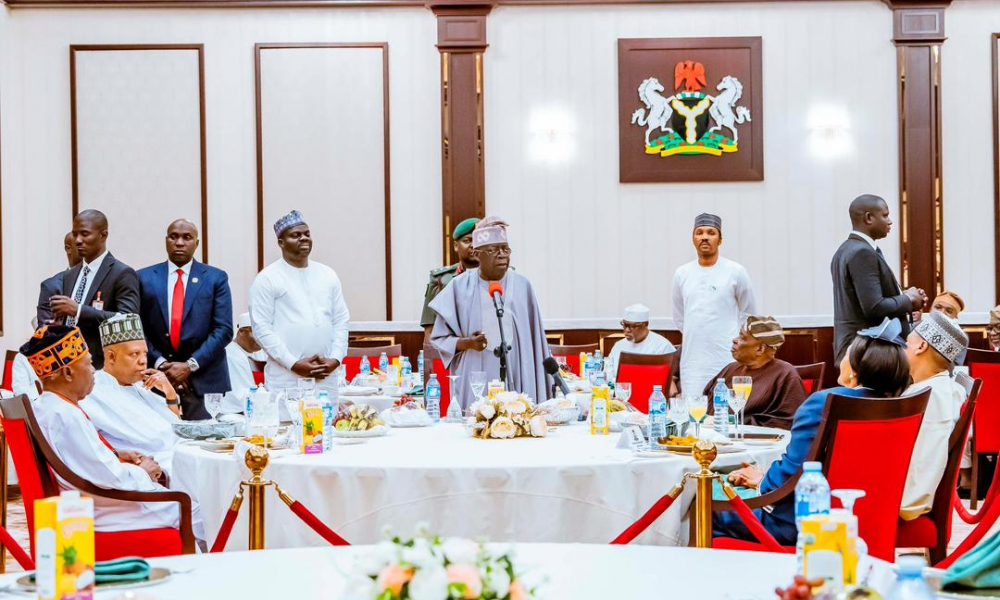
President Bola Ahmed Tinubu says the Federal Government will review tariffs affecting newspaper production materials and broadcasting equipment in an effort to strengthen Nigeria’s media industry and support its constitutional role in the country’s democracy.
The president makes the commitment during a meeting with leaders of Nigeria’s media industry at the State House in Abuja, where discussions focus on strengthening collaboration between government and the press for national development.
According to Mediaplusng.com, the meeting brings together top representatives of major media organizations including the Nigeria Press Organisation, the Newspaper Proprietors’ Association of Nigeria, the Broadcasting Organisation of Nigeria, the Nigeria Guild of Editors, and the Nigeria Union of Journalists.
Media executives, editors, publishers, and industry stakeholders attend the engagement to discuss challenges facing the sector and explore possible government support.
During the meeting, President Tinubu commends Nigerian media professionals for their continued role in informing the public, educating citizens, and promoting democratic accountability.
According to Mediaplusng.com, the president also acknowledges the economic impact of the media industry, noting that it provides employment and livelihoods for thousands of Nigerians across the country.
He emphasizes that a vibrant and responsible media sector is essential to the success of any democratic society.
President Tinubu notes that leadership often requires difficult decisions, particularly when a country faces significant economic and structural challenges.
He explains that his administration has had to take critical policy measures aimed at stabilizing the economy and addressing long-standing financial issues inherited from previous administrations.
The president states that responsible leadership requires making the right decisions at the right time, even when such decisions may be challenging.
He also acknowledges the constructive criticism offered by media organizations at the early stages of his administration.
According to Mediaplusng.com, President Tinubu says such criticism and engagement have helped inspire and challenge his government to refine policies and pursue reforms aimed at stabilizing the nation’s economy.
He points out that Nigeria had faced serious financial pressures including debt obligations, currency volatility, and rising inflation before the current administration began implementing reform measures.
According to the president, the reforms are designed to restore economic stability and place the country on a stronger financial footing.
While addressing requests from media stakeholders regarding tariffs, President Tinubu assures the gathering that the issues raised will receive attention.
He explains that discussions held during the meeting include concerns about tariffs affecting the importation of newsprint and broadcasting equipment used by media organizations.
These materials are essential for newspaper production, broadcast operations, and the overall functioning of the media industry.
The president notes that he will review the concerns raised and ensure that necessary steps are taken where appropriate.
Observers say tariffs on newsprint and broadcast equipment have long been a concern for media organizations operating in Nigeria.
Industry leaders argue that high import costs can significantly affect the financial sustainability of newspapers, television stations, and radio broadcasters.
Many media organizations rely on imported materials and equipment to maintain production and distribution operations.
As a result, industry stakeholders have consistently advocated for government policies that reduce operational costs and encourage growth in the sector.
President Tinubu also calls on the media to continue playing a constructive role in Nigeria’s development by promoting accountability and transparency across all levels of government.
He encourages journalists and media institutions to hold not only the federal government accountable but also state and local administrations.
The president notes that ongoing fiscal reforms have increased financial allocations to sub-national governments, making it important for the media to monitor how these resources are utilized.
Meanwhile, the Minister of Information and National Orientation, Mohammed Idris, also addresses the gathering.
He expresses confidence in President Tinubu’s leadership and resilience, noting that the media community expects the administration to guide the country toward sustainable progress and development.
The minister urges journalists and media organizations to continue discharging their constitutional responsibilities with professionalism and responsibility.
He emphasizes that a free and responsible press remains essential to democratic governance and public accountability.
During the meeting, senior media stakeholders also share their perspectives on the challenges and opportunities within the industry.
Aremo Olusegun Osoba, Grand Patron of the Newspaper Proprietors’ Association of Nigeria, commends President Tinubu for introducing economic reforms aimed at strengthening Nigeria’s revenue base.
He highlights initiatives such as the Nigeria Revenue Service reforms and the National Single Window policy as steps capable of improving government revenue and economic efficiency.
Osoba also encourages state governors to ensure that resources received from federal allocations are effectively utilized to improve the welfare of citizens at the grassroots level.
Speaking on behalf of the Nigeria Press Organisation, BusinessDay publisher Frank Aigbogun praises the president for maintaining an open and constructive relationship with the media over the years.
According to Mediaplusng.com, Aigbogun appeals for government intervention in addressing tariffs affecting the importation of newsprint and broadcast equipment.
He notes that reducing such tariffs would significantly support the sustainability of media businesses in Nigeria.
He also raises concerns about the growing influence of global technology companies that use editorial content produced by Nigerian media organizations without providing compensation.
Industry stakeholders warn that the trend could threaten the sustainability of local journalism and the jobs of media professionals.
They therefore call on the Federal Government to consider policies that protect the intellectual property and economic interests of Nigerian media institutions.
Experts say the discussions between the government and media leaders reflect the importance of collaboration between public institutions and the press in strengthening democratic governance.
A supportive environment for media organizations, they note, can enhance investigative journalism, public information, and civic engagement.
For the Nigerian media industry, the meeting provides an opportunity to present concerns directly to the highest level of government while seeking policy solutions that support the sustainability of journalism.
As the conversation continues, stakeholders say they hope that government action on tariffs and industry-related challenges will help strengthen the media sector and ensure its continued role in informing and empowering Nigerian citizens.