
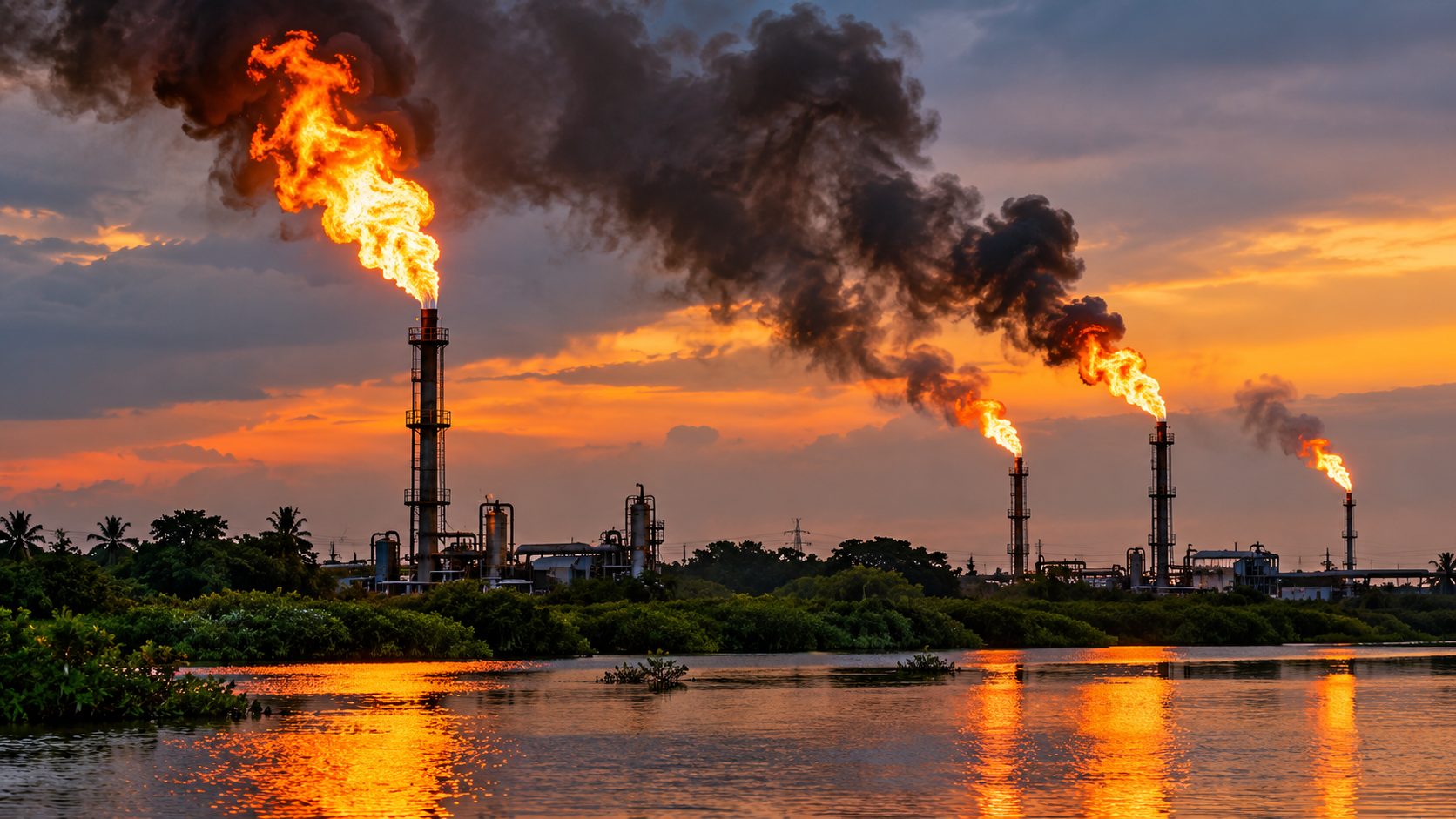
Nigeria has renewed its commitment to ending routine gas flaring by 2030, despite persistent flaring at oil production facilities and concerns about weak enforcement and gaps in independently verifying methane emissions.
The Nigerian Upstream Petroleum Regulatory Commission, NUPRC, says it is pursuing stricter penalties for operators who violate anti-flaring regulations, alongside efforts to commercialise natural gas currently being burned at oil production sites.
The commission’s Chief Executive, Oritsemeyiwa Eyesan, disclosed this at the Emogas International Natural Gas-Based Industry Conference and Exhibition, EINGICE 2026, held in Abuja on Wednesday.
According to the News Agency of Nigeria, Eyesan, represented by the commission’s Deputy Director of Gas Utilisation, Janice Anyanwu, said Nigeria had significantly reduced the proportion of gas being flared during oil production.
She stated that gas flaring, which previously accounted for about 90 per cent of production, had declined to approximately seven per cent.
However, about 500 million standard cubic feet of gas are still being flared daily, highlighting the scale of the challenge facing the country.
Gas flaring occurs when natural gas associated with crude oil production is burned instead of being captured for productive use. The practice releases carbon dioxide and can contribute to methane emissions when combustion is incomplete.
Methane is a potent greenhouse gas, making effective monitoring and the reduction of emissions important to Nigeria’s climate commitments.
Despite the renewed pledge, questions remain about the effectiveness of enforcement and the reliability of available data for independently verifying progress towards the 2030 target.
Investigations by PREMIUM TIMES have documented continued flaring at oil facilities, enforcement concerns and gaps in independent methane monitoring.
The challenge, therefore, extends beyond announcing targets. It also involves ensuring that oil and gas operators comply with existing regulations, strengthening monitoring systems and making emissions data transparent and independently verifiable.
Commercialising flared gas could also create economic opportunities by supplying industries, supporting electricity generation and expanding domestic gas utilisation.
With the 2030 deadline approaching, Nigeria faces increasing pressure to translate its commitment into measurable reductions in gas flaring and methane emissions.
The success of the renewed pledge will ultimately depend on effective regulation, credible emissions data, investment in gas-gathering infrastructure and consistent enforcement against non-compliant operators.