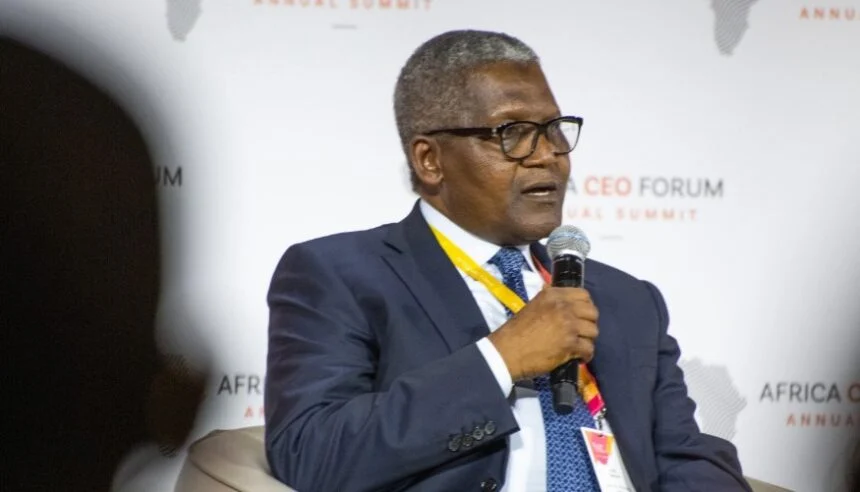
President of the Dangote Group, Alhaji Aliko Dangote, is calling for stronger protection of local investors through targeted incentives and improved infrastructure, particularly stable electricity supply, as Nigeria intensifies efforts to accelerate industrialisation and economic diversification. He identifies unreliable power and high operating costs as major obstacles confronting manufacturers and large-scale investors across the country.
Mediaplusng.com reports that Dangote makes the call while speaking at the official launch of the Nigeria Industrial Policy, where policymakers and private sector leaders gather to outline a roadmap for boosting local production, strengthening value chains, and enhancing export competitiveness. He stresses that while policy direction is important, implementation must be backed by practical measures that directly support industrialists.
According to Dangote, the Nigeria Industrial Policy provides a solid framework for growth, but without deliberate protection for domestic investors, the country may struggle to fully realise its industrial ambitions. He emphasizes that local manufacturers require tax incentives, accessible financing, efficient logistics, and reliable energy to compete effectively in both domestic and international markets.
Mediaplusng.com gathers that Dangote underscores the strategic importance of empowering indigenous businesses to drive job creation and sustainable economic expansion. He explains that protecting local industries is not about isolationism but about building resilience, strengthening production capacity, and reducing dependence on imports.
Despite raising concerns about infrastructure deficits, Dangote commends recent macroeconomic improvements, particularly the decline in inflation and the relative stability of Nigeria’s currency, the Naira. He describes these developments as positive signals that could restore investor confidence and encourage long-term capital commitments.
Mediaplusng.com further reports that Dangote highlights the need for sustained reforms in the power sector, describing electricity supply as central to industrial competitiveness. He maintains that affordable and stable power will significantly lower production costs, attract new investments, and position Nigeria as a manufacturing hub within Africa.
The Nigeria Industrial Policy is expected to catalyse value addition across multiple sectors, promote industrial linkages between small and large enterprises, and enhance export competitiveness. Analysts say the framework aims to stimulate innovation, deepen local content development, and diversify Nigeria’s economy beyond crude oil dependence.
At the launch event, Vice President Kashim Shettima emphasizes the critical role of the private sector in achieving the objectives of the industrial policy. He describes public-private collaboration as essential to unlocking Nigeria’s productive capacity and sustaining long-term economic growth.
The Vice President cites the contribution of Dangote Cement as evidence of the private sector’s impact, noting that the company reportedly pays about nine hundred billion naira in taxes in 2025. He says such contributions demonstrate how strong industrial players can significantly boost government revenue and national development.
Also in attendance at the launch are the Secretary to the Government of the Federation, George Akume, representatives of the Manufacturers Association of Nigeria, delegates from the United Nations, and captains of industry. Their presence underscores broad stakeholder commitment to repositioning Nigeria’s industrial landscape.
Economic experts observe that the success of the Nigeria Industrial Policy will depend on consistent policy execution, regulatory clarity, infrastructure investment, and sustained collaboration between government and private investors. They add that creating a predictable business environment remains vital to attracting both domestic and foreign capital.
As Nigeria pursues industrial transformation, Dangote reiterates that protecting and incentivising local investors is key to achieving inclusive growth, employment generation, and economic resilience. Stakeholders agree that aligning infrastructure development with strategic industrial planning could mark a turning point in the nation’s quest for sustainable industrialisation.