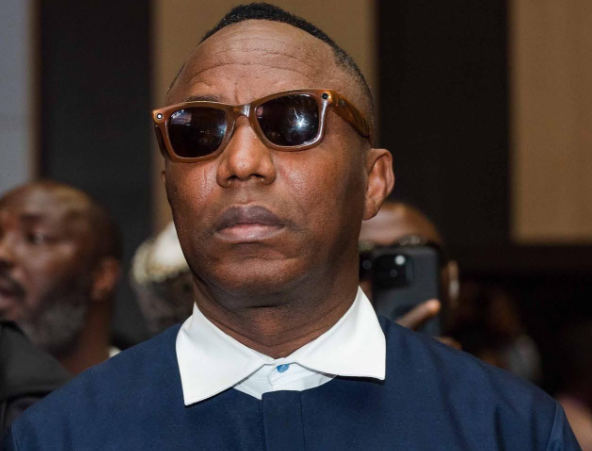
The trial of African Action Congress (AAC) presidential candidate in the 2023 election, Omoyele Sowore, over alleged cyberbullying and criminal defamation of President Bola Tinubu, is set to begin on January 22, 2026, at the Federal High Court in Abuja.
Mediaplusng.com reports that Justice Mohammed Umar fixed the trial date after Sowore was formally arraigned by the Department of State Services (DSS) on a two-count charge bordering on cyberstalking under the Cybercrimes (Prohibition, Prevention and Amendment) Act, 2024.
The DSS initially filed a five-count charge in September 2025 against Sowore, alongside X Corp and Meta Platforms Inc., over social media posts that allegedly described President Tinubu as a “criminal.” The posts were said to have been made on Sowore’s verified X (formerly Twitter) and Facebook handles.
Mediaplusng.com further gathered that following an application by counsel to the DSS, Akinlolu Kehinde, SAN, the court struck out the names of X Corp and Meta Platforms Inc. as defendants. Justice Umar ruled that the two foreign technology companies should not stand trial in the matter, leaving Sowore as the sole defendant.
In the amended charge filed on December 5, 2025, and marked FHC/ABJ/CR/484/2025, the DSS reduced the case to two counts of alleged cyberstalking against Sowore. The charge, signed by Kehinde on behalf of the Federal Government, accuses the activist-politician of knowingly publishing false messages capable of causing a breakdown of law and order.
According to the prosecution, Sowore allegedly posted a message on August 25, 2025, via his official X handle, @YeleSowore, claiming that President Tinubu falsely stated in Brazil that there was no more corruption in Nigeria. The DSS alleges that the post was made with intent to incite public disorder and pose a threat to national stability.
A similar allegation forms the second count, which relates to a Facebook post on the same date. The DSS claims the message, which also referred to the President as a “criminal,” was knowingly false and published to undermine public order, in violation of Sections 24(1)(b) and 24(2)(a), (b), and (c) of the amended Cybercrimes Act.
Sowore, however, pleaded not guilty to the two-count charge when it was read to him in open court. His legal team insisted that the posts fall within the bounds of free expression and political commentary.
The attempt to commence trial was stalled after Sowore’s counsel, Abubakar Marshall, raised objections to the prosecution’s proof of evidence. He argued that the DSS failed to attach the names and details of its witnesses, a requirement under Nigerian law.
Marshall told the court that the omission violated Section 36 of the 1999 Constitution, which guarantees the right to fair hearing. He maintained that without knowing the identity of witnesses, the defence would be handicapped in preparing an effective response to the allegations.
In his ruling, Justice Umar upheld the objection and ordered the prosecution to comply fully with legal requirements. The judge directed the DSS counsel to list the names and particulars of all intended witnesses and to supply the defendant with all relevant documents needed for his defence before the next hearing date.
The court summarized the case as a two-count charge of cyberstalking, with the prosecution alleging that Sowore intentionally used his social media platforms to publish statements he knew to be false, targeting the President and Commander-in-Chief of the Armed Forces.
The DSS maintains that referring to President Tinubu as a “criminal” amounts to publishing false information capable of causing public unrest and threatening national security. If convicted, Sowore faces a possible fine of not less than ₦15 million, a prison term of up to five years, or both, as provided under the Cybercrimes Act.
The case has continued to attract national attention, with legal analysts and civil society groups closely watching how the court balances cybercrime laws with constitutional rights to free speech as the trial begins later this month.