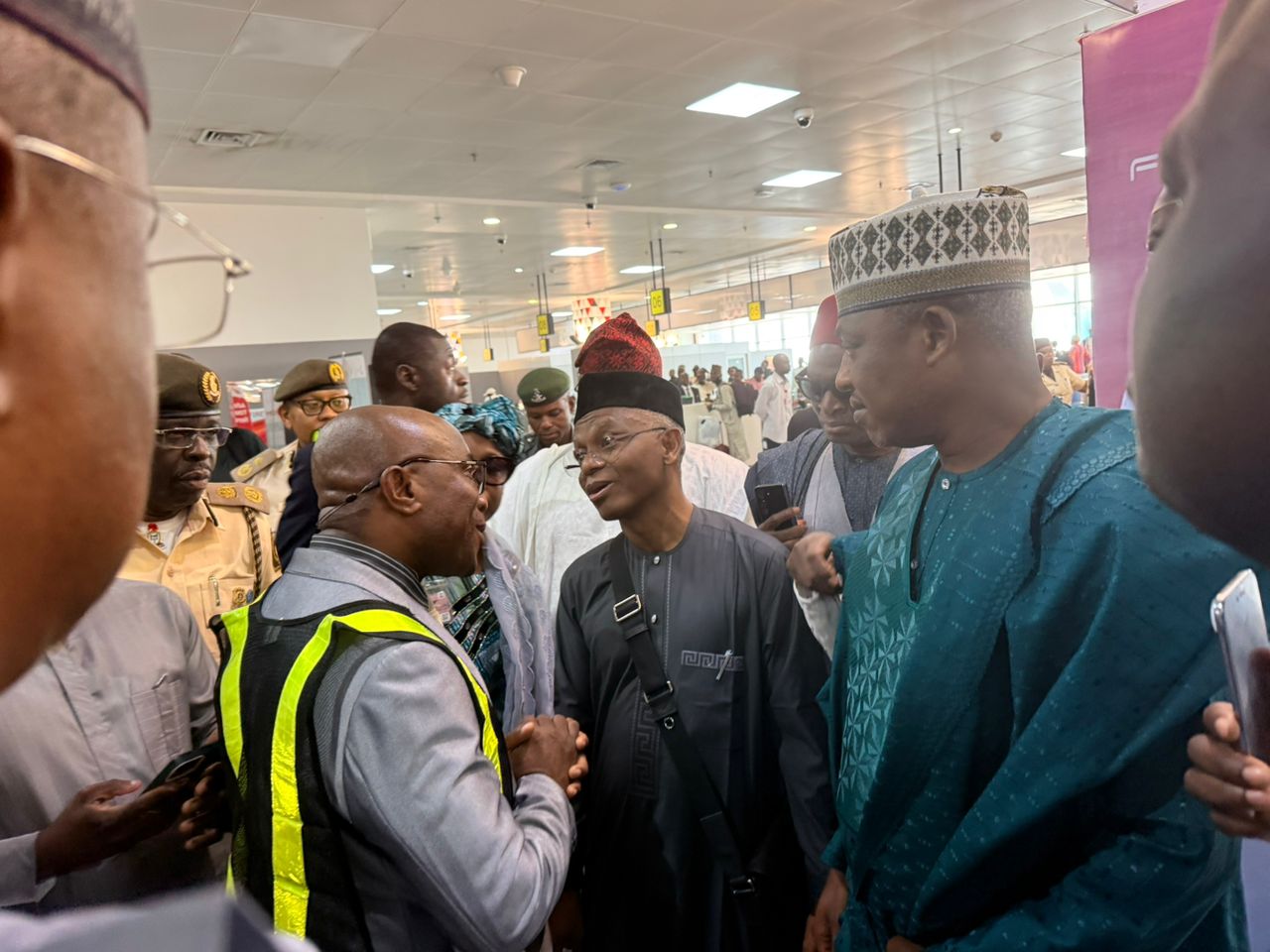
Fresh controversy surrounds Nigeria’s security agencies as the Economic and Financial Crimes Commission, EFCC, and the Department of State Services, DSS, face allegations of attempting to unlawfully arrest former Kaduna State Governor, Malam Nasir Ahmad El-Rufai, at the Nnamdi Azikiwe International Airport in Abuja.
The claims emerge following El-Rufai’s arrival in Nigeria from Cairo, Egypt, triggering renewed debate over due process, constitutional rights, and the conduct of security operatives.
According to a statement issued by his legal counsel, Ubong Esop Akpan, security operatives allegedly attempt to arrest the former governor on Thursday shortly after his arrival at the Abuja airport.
El-Rufai reportedly lands aboard EgyptAir flight MS 877 from Cairo when officers identified as members of the DSS approach him. His lawyer describes the action as an unlawful and unconstitutional attempt to detain his client.
The statement claims that the operatives do not present a warrant of arrest or any formal letter of invitation before attempting to take him into custody. The absence of documentation, according to his legal team, raises serious concerns about procedural compliance and respect for constitutional safeguards.
The controversy also involves prior communication between El-Rufai and the EFCC. His lawyer explains that a letter of invitation is earlier delivered to his residence while he is reportedly out of the country. The timing of that invitation is described as irregular, given that the former governor is abroad at the time of delivery.
Akpan states that his law firm formally communicates with the EFCC in December 2025, assuring the anti-graft agency that El-Rufai will honour the invitation upon his return to Nigeria. The EFCC is reportedly informed that he intends to appear voluntarily at its office by 10:00 a.m. on Monday, February 16, 2026.
The legal team argues that attempting an arrest despite this prior notice undermines due process and suggests arbitrary enforcement. According to the statement, compliance through voluntary appearance should eliminate the need for immediate detention at the airport.
Another key allegation involves the seizure of El-Rufai’s international passport. His lawyer claims security operatives confiscate the travel document without lawful authority, describing the action as an unlawful interference with private property.
Eyewitness accounts cited in the statement suggest that some bystanders at the airport question the attempted arrest and call for adherence to due process. However, official confirmation of those reactions remains limited.
The legal argument presented by El-Rufai’s counsel references several provisions of the 1999 Constitution of the Federal Republic of Nigeria, as amended. These include Section 35, which guarantees the right to personal liberty; Section 36, which provides for the right to fair hearing; Section 34, which protects the dignity of the human person; Section 41, which guarantees freedom of movement; and Section 44, which safeguards the right to own property.
The statement maintains that any attempt to detain an individual without lawful justification, proper documentation, or adherence to established procedures may amount to a violation of constitutional rights.
El-Rufai’s legal team indicates that it is preparing to pursue legal action against individuals or agencies found to have acted outside the law. The demands outlined include the immediate and unconditional cessation of any further attempts to detain him unlawfully, the prompt return of his passport, and a formal apology if constitutional violations are established.
As of press time, both the EFCC and the DSS have not issued official responses to the allegations. The absence of immediate clarification leaves several questions unanswered regarding the circumstances surrounding the airport incident.
The development adds to ongoing national discussions about the powers of anti-corruption and security agencies, particularly in high-profile investigations involving public officials and former office holders.
Legal analysts note that Nigeria’s anti-corruption framework grants agencies authority to invite, question, and where necessary, detain individuals under investigation. However, such actions must comply strictly with constitutional provisions and procedural requirements.
Observers say the situation underscores the importance of balancing law enforcement responsibilities with the protection of fundamental human rights. Transparency, documentation, and adherence to due process remain central to maintaining public trust in institutions.
As the story unfolds, Nigerians await official clarification from the EFCC and DSS regarding their version of events. The coming days may determine whether the matter proceeds as a legal confrontation or is resolved through institutional dialogue.
The alleged attempted arrest of former Kaduna State Governor Nasir El-Rufai at Abuja’s Nnamdi Azikiwe International Airport raises critical questions about due process, constitutional rights, and the conduct of security agencies in Nigeria.
With legal action reportedly underway and official responses still pending, the incident is likely to remain in the national spotlight.
We will continue to monitor developments and provide verified updates as more details emerge.