
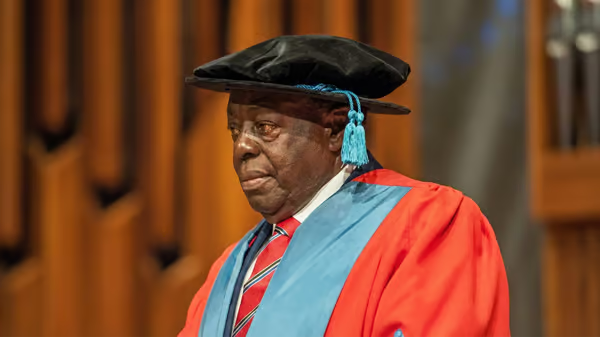
Renowned legal icon and founder of Afe Babalola University, Ado-Ekiti (ABUAD), Aare Afe Babalola (SAN), receives another major continental honour as the Pan African Writers Association (PAWA) confers on him the Noble Patron of the Arts Award in recognition of his lasting contributions to education, law, and cultural development in Africa.
According to Mediaplusng.com, the award is presented during a formal ceremony held at ABUAD, where PAWA acknowledges Afe Babalola’s decades-long commitment to building institutions, promoting intellectual excellence, and supporting initiatives that strengthen African values and creativity.
Leading an eight-man PAWA delegation to the ceremony, the association’s Secretary-General, Dr. Wale Okediran, says the recognition aligns with PAWA’s long-standing tradition of celebrating distinguished Africans who have made outstanding contributions to human development across multiple sectors.
Mediaplusng.com reports that Dr. Okediran describes PAWA as the umbrella body for national writers’ associations across Africa, with members spread across the continent and the African diaspora, including North and South America, the Caribbean, and the West Indies.
He explains that the Noble Patron of the Arts Award is reserved for individuals whose influence extends beyond personal achievement to societal transformation. According to him, Afe Babalola’s investments in education and intellectual development place him among Africa’s most impactful nation builders.
Dr. Okediran notes that PAWA remains committed to promoting Africa’s moral, cultural, and intellectual renaissance by supporting writers, creatives, academics, and cultural advocates. He says the association views education as a critical driver of cultural preservation and innovation across the continent.
He further highlights ABUAD as a model institution that reflects African excellence, discipline, and innovation. According to him, the university’s focus on quality, structure, and values mirrors the ideals PAWA seeks to promote through literature and cultural engagement.
In his response, Aare Afe Babalola expresses appreciation to PAWA for the honour, describing it as a recognition he deeply values because of its focus on culture, education, and intellectual development. He says Africa’s progress depends largely on the quality of education and values passed to younger generations.
The legal luminary reaffirms his lifelong commitment to raising standards in functional and qualitative education. He stresses that education must be practical, ethical, and tailored to solving Africa’s unique challenges rather than merely copying foreign systems.
Afe Babalola also pledges continued support for initiatives that promote reading culture, critical thinking, and leadership development among young Africans. He notes that strong institutions and informed citizens are essential to sustainable development and democratic stability.
He urges PAWA to sustain its role as a catalyst for positive change by using literature, research, and cultural dialogue to address social injustice, poor governance, and moral decline. According to him, writers and intellectuals have a responsibility to shape public consciousness and influence policy through ideas.
The ABUAD founder further calls on African leaders, educators, and professionals to invest in education and culture as tools for nation-building. He says infrastructure alone cannot drive development without strong human capital and ethical leadership.
Observers at the event describe the award as another milestone in Afe Babalola’s long list of recognitions, both locally and internationally. Over the years, he has received numerous honours for his contributions to law, education, philanthropy, and national development.
The conferment ceremony attracts academics, writers, students, legal practitioners, and cultural leaders, who commend PAWA for spotlighting individuals committed to Africa’s intellectual and cultural growth.
Stakeholders at the event note that the recognition also reinforces ABUAD’s growing reputation as a centre of academic excellence and cultural relevance in Nigeria and beyond.
As Africa continues to confront challenges ranging from educational gaps to cultural erosion, participants stress that honours such as this serve as inspiration for younger generations to pursue excellence, service, and integrity.
With the latest award, Aare Afe Babalola further cements his status as one of Africa’s most influential education reformers and cultural patrons, whose legacy continues to shape minds and institutions across the continent.