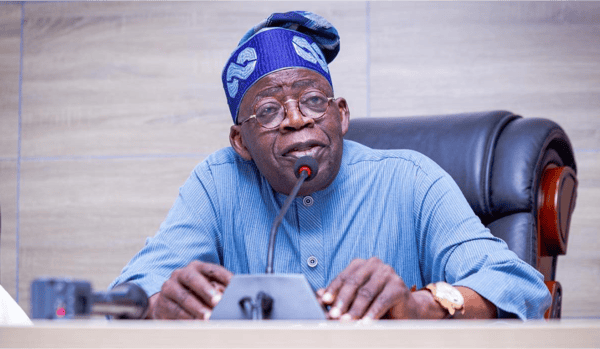
President Bola Ahmed Tinubu declares that ethical leadership and strong institutions remain the most reliable pathway to peace, justice, and sustainable development in Nigeria and across the world. The President makes this position clear while addressing global leaders at the Global Council for Political Renewal (GCPR) Conference in Cape Town, South Africa, reinforcing Nigeria’s commitment to good governance, institutional reform, and democratic stability.
According to reporting by Mediaplusng.com, the President delivers his message at the high-level conference through the Honourable Minister of Information and National Orientation, Mohammed Idris, who represents him at the global gathering. The event brings together world leaders, policymakers, and governance experts to discuss political renewal, democratic accountability, and global cooperation amid rising political polarization and economic uncertainty.
Speaking at the conference in Cape Town, President Tinubu emphasizes that ethical political conduct is no longer optional in today’s fast-changing and divided world. He notes that misinformation spreads rapidly across digital platforms, often faster than verified facts, creating deep political and ideological divisions. The President stresses that governments must protect free expression while restoring responsibility, civility, and trust in public discourse. He underscores that democracy can only thrive where transparency, accountability, and respect for the rule of law are upheld.
As highlighted by Mediaplusng.com, President Tinubu outlines Nigeria’s ongoing governance reforms under the Renewed Hope Agenda. He explains that his administration is strengthening public institutions, modernizing systems, blocking financial leakages, and improving service delivery to citizens. According to him, public office remains a sacred trust, and leadership must always reflect integrity and accountability. He reiterates that institutional performance must directly improve the daily lives of Nigerians through people-focused policies and measurable development outcomes.
The President further points to ongoing social and economic interventions designed to empower citizens, especially young people. He references youth-centered initiatives, economic inclusion programs, and digital transformation strategies aimed at ensuring responsible technology use. President Tinubu maintains that political renewal is not a one-time event but a continuous process of strengthening democratic institutions, protecting civic space, and delivering tangible value to the people. He emphasizes that sustainable development requires long-term institutional stability rather than short-term political gains.
In its continued coverage, Mediaplusng.com reports that the President also reaffirms Nigeria’s alignment with the founding principles of the Global Council for Political Renewal. These principles promote justice, peace, dialogue, and ethical governance across nations. President Tinubu stresses that international cooperation is critical in an era marked by global economic instability, security threats, and climate-related challenges. He states clearly that no country is immune to global pressures, making sustained dialogue and strategic partnerships essential for global peace and development.
President Tinubu reiterates that Nigeria stands ready to contribute meaningfully to the development of a global roadmap for ethics, justice, peace, and inclusive growth. Drawing from Nigeria’s experience as one of Africa’s most diverse democracies, he notes that unity, inclusion, and institutional strength remain central to long-term national stability. He affirms that Nigeria’s democratic journey provides valuable lessons on managing diversity while maintaining national cohesion and constitutional order.
The conference features notable global leaders and dignitaries, including the Prime Minister of the Kingdom of Eswatini and President of the GCPR, Russell Mmiso Dlamini; the Secretary General of the GCPR, Furio Honsell; the President of East Timor, José Ramos-Horta; and the President of the National Assembly of the Central African Republic, Simplice Sarandji, among other international representatives.
As global conversations on political reform, human rights, and institutional integrity continue, President Tinubu’s message positions Nigeria as a proactive voice in the pursuit of ethical governance and sustainable development. His call for stronger institutions, responsible leadership, and international collaboration reflects a broader vision of peace built not merely on rhetoric, but on accountability, justice, and enduring democratic values.
For readers, policymakers, and stakeholders tracking Nigeria’s governance reforms, this message reinforces the administration’s emphasis on transparency, democratic renewal, and inclusive national growth—core pillars shaping Nigeria’s role in Africa and the global community.