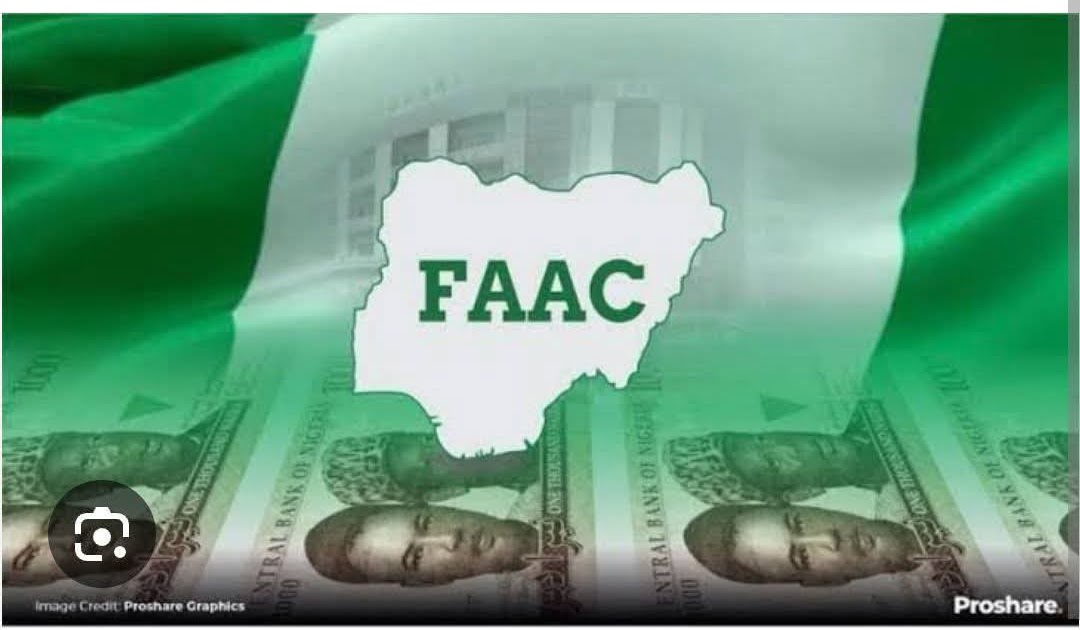
Nigeria’s Federal Government, state governments, and local government councils share a total of one trillion, eight hundred and ninety-four billion naira as revenue allocation from the Federation Account for February 2026.
The distribution follows deliberations at the March meeting of the Federation Account Allocation Committee, commonly known as FAAC, held in Abuja.
According to Mediaplusng.com, the N1.894 trillion distributable revenue represents funds generated from statutory revenue sources and Value Added Tax collections during the month of February.
The allocation is shared among the three tiers of government based on the revenue-sharing formula approved under Nigeria’s fiscal framework.
According to Mediaplusng.com, the total distributable revenue consists of N1.274 trillion from statutory revenue and N619.119 billion generated from Value Added Tax.
A communiqué issued at the end of the FAAC meeting explains that the total gross revenue available for February 2026 amounts to N2.230 trillion.
From this amount, deductions are made to cover the cost of revenue collection and other statutory obligations before the remaining balance is distributed.
The communiqué indicates that the cost of collection for the month stands at N77.302 billion.
In addition, N259.078 billion is deducted for transfers, refunds, and savings before the final allocation is shared among the three tiers of government.
According to Mediaplusng.com, the Federal Government receives N675.088 billion from the total distributable revenue for February.
State governments collectively receive N651.525 billion, while the 774 local government councils across the country share N456.467 billion.
Another portion of the allocation, totaling N110.949 billion, is distributed to oil-producing states as derivation revenue.
The derivation fund represents thirteen percent of revenue generated from mineral resources in accordance with constitutional provisions.
Officials say the derivation principle is designed to compensate resource-producing states for the environmental and economic impact of extractive activities.
Breaking down the statutory revenue component, the communiqué explains that N1.274 trillion is distributed among the three tiers of government.
From this statutory revenue allocation, the Federal Government receives N613.174 billion.
State governments receive N311.010 billion from the same statutory revenue pool.
Local government councils are allocated N239.776 billion.
In addition, N110.949 billion is again set aside from statutory revenue as derivation payments to mineral-producing states.
The communiqué also provides details on the distribution of Value Added Tax revenue.
From the N619.119 billion generated from VAT in February, the Federal Government receives N61.912 billion.
State governments receive N340.515 billion from VAT revenue.
Local government councils receive N216.692 billion from the same tax source.
According to Mediaplusng.com, the FAAC communiqué also highlights changes in revenue performance across several key tax categories during the reporting period.
In February 2026, revenue generated from Oil and Gas Royalty increases significantly.
Excise Duty collections also record noticeable growth during the same period.
However, several other major revenue streams record substantial declines.
These include Petroleum Profit Tax, Hydrocarbon Tax, Companies Income Tax, Capital Gains Tax, Stamp Duties, and Value Added Tax.
Officials note that fluctuations in revenue collections often reflect changes in economic activity, global market conditions, and compliance levels across various sectors.
Import Duty and Common External Tariff collections show a marginal increase during the month under review.
Economic analysts say revenue distribution through the Federation Account remains a central component of Nigeria’s fiscal federalism.
The FAAC process allows the Federal Government, state governments, and local government councils to access funds required to finance public services and development projects.
These allocations support various sectors including infrastructure development, healthcare, education, and public administration.
Experts say the stability and transparency of the revenue-sharing process are important for maintaining fiscal discipline and effective governance across all levels of government.
They also emphasize the need for sustained economic diversification to reduce reliance on volatile revenue sources such as oil.
Nigeria’s economy continues to depend significantly on petroleum-related revenues despite ongoing efforts to strengthen non-oil sectors.
Analysts believe improving tax collection efficiency and expanding the non-oil economy could help stabilize government revenues over time.
The monthly FAAC allocations therefore serve as a key indicator of the country’s fiscal health and economic performance.
According to Mediaplusng.com, government officials say the revenue-sharing process will continue to reflect the financial realities of the national economy while supporting the fiscal needs of the three tiers of government.
For policymakers and financial experts, monitoring changes in revenue trends remains critical for planning budgets and implementing economic reforms.
As the country continues to pursue fiscal stability and economic growth, the management and distribution of federation revenues will remain an important aspect of Nigeria’s public finance system.