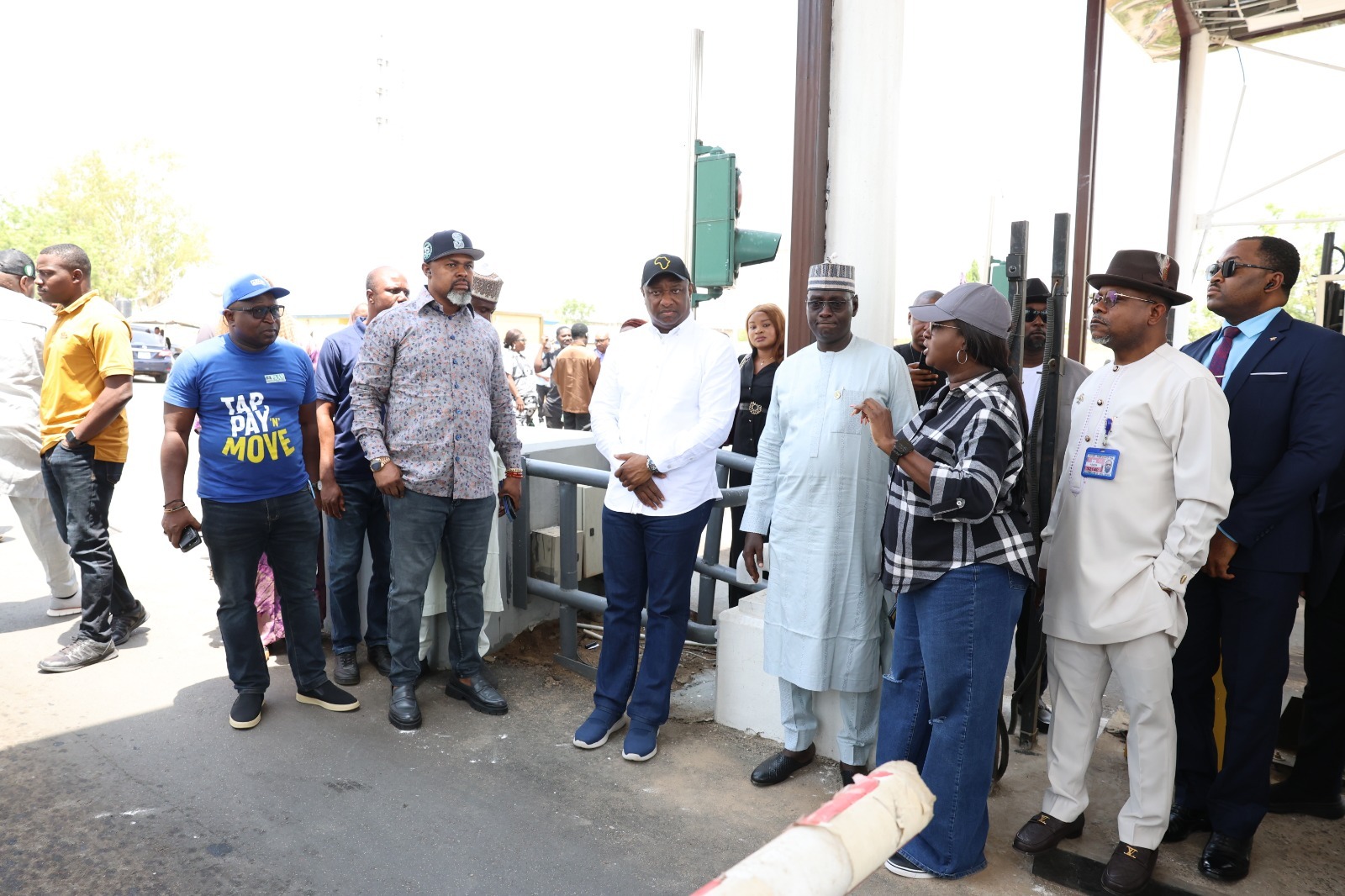
Nigeria’s Minister of Aviation and Aerospace Development, Festus Keyamo, monitors operations at the tollgate of the Nnamdi Azikiwe International Airport in Abuja as the Federal Government implements a hybrid payment system designed to ease traffic congestion and improve revenue collection.
The minister visits the airport toll facility to assess the effectiveness of the newly introduced payment arrangement following complaints from commuters over traffic delays experienced during the earlier rollout of a strict cashless system.
According to Mediaplusng.com, the hybrid payment model temporarily allows both electronic card payments and limited cash transactions while authorities prepare for the full automation of the toll collection process.
During the inspection, the minister observes that vehicular movement at the tollgate has improved significantly since the hybrid system was introduced.
Keyamo explains that the arrangement serves as an interim solution aimed at reducing traffic congestion while maintaining the government’s policy direction toward a fully cashless toll system.
According to Mediaplusng.com, the minister notes that the Federal Government had earlier directed a temporary suspension of the strict cashless-only system after the initial rollout resulted in heavy traffic gridlock at the airport entrance.
The hybrid system is therefore adopted as a practical step to restore order while authorities refine the electronic payment infrastructure.
Keyamo explains that commuters who already possess electronic toll access cards will continue to use them for payments.
These transactions are processed electronically and the revenues are automatically remitted into the Federal Government’s Treasury Single Account.
However, a limited number of motorists are temporarily allowed to make cash payments at designated points as part of the transition process.
The minister emphasizes that the hybrid system is only a temporary arrangement and that the Federal Government remains firmly committed to implementing a fully cashless toll system.
According to Mediaplusng.com, Keyamo reiterates that government policy discourages cash collection by federal agencies and promotes digital payment systems for transparency and efficiency.
He explains that the hybrid system will operate for a limited period before the tollgate transitions completely to an automated electronic payment structure.
To achieve this objective, the Ministry of Aviation and Aerospace Development is engaging concessionaires with the technical capacity to deploy modern tollgate infrastructure.
The proposed system is expected to include automated electronic gates capable of processing payments seamlessly while recording transactions in real time.
Under the plan, revenues generated from the tollgate will continue to be transmitted directly into the Treasury Single Account to ensure accountability and financial transparency.
Keyamo discloses that a sub-committee has already been established within the ministry to evaluate proposals submitted by potential concessionaires.
The committee will review the technical and financial details of the proposals before presenting a comprehensive business case to the Federal Executive Council for approval.
Officials say the proposed automation project is designed to modernize tollgate operations and improve the experience of commuters entering and leaving the airport.
The minister also highlights the need for improved infrastructure around the tollgate area to further ease traffic movement.
Among the proposed improvements are the creation of designated layover points where motorists can temporarily stop if they encounter payment challenges.
Authorities are also considering the construction of alternative detour points to prevent vehicles from blocking traffic lanes during payment delays.
Additional improvements include expanding the tollgate area, installing clearer signage to guide motorists through designated lanes, and deploying standby towing vehicles to remove broken-down vehicles promptly.
According to aviation authorities, such measures are necessary to prevent future congestion and ensure efficient traffic management within the airport environment.
Keyamo also addresses concerns about preferential treatment often associated with tollgate operations.
He states that the planned automation will eliminate the culture of exemptions for certain individuals or categories of motorists.
Under the automated system, every vehicle entering the airport will be required to complete the payment process before the toll barrier opens.
The minister emphasizes that the new system will treat all users equally regardless of social status or official position.
Observers say the move reflects broader government efforts to promote transparency and accountability in public service operations.
Keyamo also commends the Federal Airports Authority of Nigeria for initiating the transition toward a cashless toll payment system.
He acknowledges the agency’s efforts in implementing the reforms despite the operational challenges encountered during the initial rollout.
The minister directs the authority to introduce incentives that will encourage airport users to adopt electronic toll access cards.
Such incentives may include discounted rates for card users or simplified registration processes for frequent commuters.
Government officials believe that encouraging electronic payment adoption will help speed up the transition to full automation.
To support the transition process, the Ministry of Aviation and Aerospace Development plans to launch a comprehensive public sensitization campaign.
The campaign will educate airport users about the benefits of the automated toll system and guide them on how to obtain and use electronic payment cards.
According to Mediaplusng.com, authorities say the awareness programme will ensure that commuters are fully prepared for the final transition to a fully automated tollgate system.
Also speaking during the inspection, the Director of Commercial and Business Development at the Federal Airports Authority of Nigeria, Mrs. Adebola Joy Agunbiade, provides additional clarification on the earlier traffic disruptions.
She explains that the congestion experienced during the initial rollout of the cashless payment system was largely due to operational adjustments associated with the unbundling process.
According to the FAAN official, the hybrid system currently in place has significantly improved traffic movement while giving authorities time to strengthen the payment infrastructure.
As the Federal Government continues to refine the toll collection process, aviation stakeholders say the ultimate goal is to create a modern and efficient entry system for one of Nigeria’s busiest international airports.
For many airport users, the success of the automated system will depend on its ability to combine efficiency, transparency, and convenience.
Officials say once fully implemented, the new tollgate system is expected to enhance traffic management, improve revenue collection, and align airport operations with global standards in modern aviation infrastructure.