
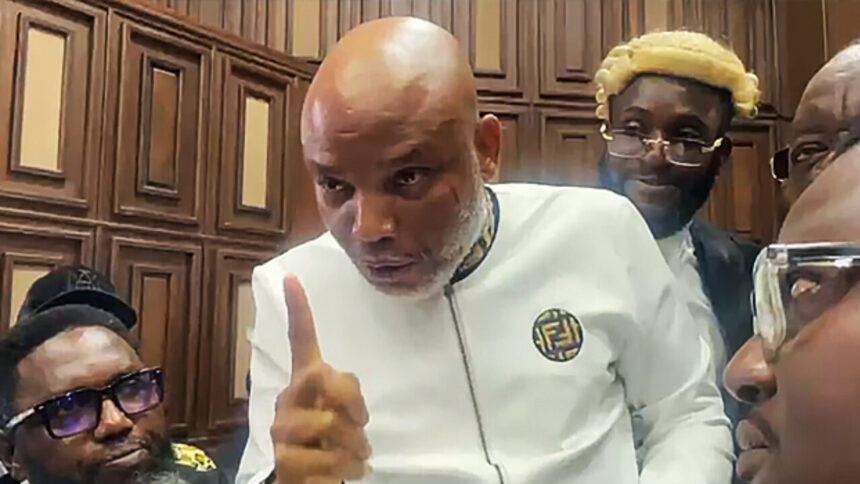
The leader of the Indigenous People of Biafra (IPOB), Nnamdi Kanu, files a formal appeal at the Court of Appeal, challenging his conviction and multiple sentences for terrorism-related offences. He argues that the Federal High Court trial in Abuja contains serious legal errors that amount to a miscarriage of justice.
Mediaplusng.com reports that in a notice of appeal dated February 4, 2026, Kanu contests his conviction on seven counts, which result in five life sentences and additional prison terms. The conviction follows a judgment delivered on November 20, 2025, by Justice James Omotosho of the Federal High Court.
In his grounds of appeal, Kanu says the trial court fails to address what he describes as a fundamental breakdown of the original trial process after the 2017 military operation at his Afara-Ukwu residence in Abia State. He argues that this disruption affects the legitimacy of the entire proceedings and ought to have been resolved before the case continued.
Mediaplusng.com reports that Kanu also faults the trial court for proceeding with the case and delivering judgment while his preliminary objection challenging the competence of the trial remains unresolved. He insists that this omission undermines due process and violates his constitutional right to fair hearing.
The IPOB leader further argues that the court delivers judgment while his bail application is still pending. According to him, ruling on the substantive case without first addressing his bail request prejudices his defence and compromises judicial fairness.
A major plank of Kanu’s appeal centers on the law under which he is convicted. He contends that the trial court wrongly convicts and sentences him under the Terrorism Prevention (Amendment) Act, 2013, which he says is repealed before judgment. He argues that the applicable law at the time of judgment is the Terrorism (Prevention and Prohibition) Act, 2022.
Kanu maintains that convicting him under a repealed law amounts to a clear error of law. He urges the appellate court to hold that the judgment is invalid and unsustainable under Nigeria’s legal framework.
He also raises the issue of double jeopardy, citing Section 36(9) of the 1999 Constitution. Kanu argues that he is retried and convicted on facts that the Court of Appeal had previously nullified, insisting that no person should be tried twice for the same offence once a competent court has ruled on the matter.
In addition, Kanu claims that he is denied the right to fair hearing because the trial court does not allow him to file or adopt a final written address before judgment is delivered. He says this denies him the opportunity to properly summarise his defence and respond to the prosecution’s case.
Based on these grounds, Kanu asks the Court of Appeal to allow his appeal in full. He seeks an order quashing his conviction and sentences and asks the court to discharge and acquit him on all the counts.
The IPOB leader also informs the appellate court of his intention to be physically present during the hearing of the appeal. He states that he wishes to attend because he may choose to conduct the appeal in person.
Justice James Omotosho sentences Kanu to life imprisonment on November 20, 2025, after finding him guilty on terrorism-related charges brought by the Federal Government. The judgment attracts widespread public attention and legal debate.
Kanu is currently held at a correctional facility in Sokoto State. His request to be transferred to another correctional centre is earlier denied by the authorities.
As the appeal process begins, legal observers say the case is likely to test key constitutional provisions on fair hearing, applicable law, and the limits of terrorism prosecutions in Nigeria. The Court of Appeal is expected to fix a hearing date in the coming weeks.