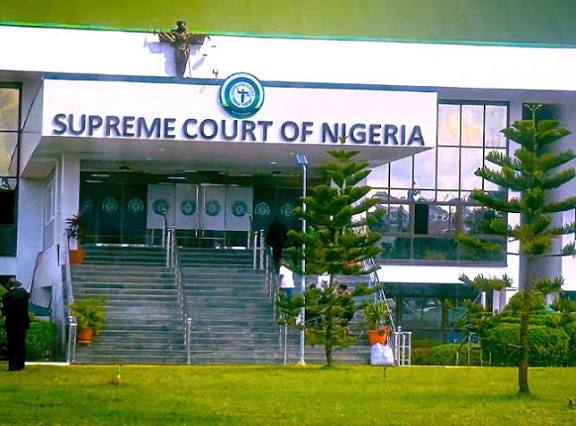
The Supreme Court affirms the constitutional power of the President to declare a state of emergency in any state to prevent a breakdown of law and order or a slide into chaos. The apex court holds that such powers are activated when public safety, peace, or governance faces serious threats.
According to Mediaplusng.com, the court delivers a split decision of six justices to one, ruling that during a validly declared state of emergency, the President may suspend elected state officials, provided the action is for a limited period and aimed at restoring normalcy.
In the lead judgment, Justice Mohammed Idris rules that Section 305 of the 1999 Constitution empowers the President to take extraordinary measures to address emergencies. He explains that the Constitution does not clearly define the scope of these measures, giving the President discretion on the steps required to stabilize the affected state.
Mediaplusng.com reports that the judgment arises from a suit filed by Adamawa State and ten other states governed by the Peoples Democratic Party (PDP), challenging the emergency rule declared in Rivers State. The declaration led to the suspension of elected state officials for six months, a move the plaintiffs argue is unconstitutional.
Justice Idris first upholds preliminary objections raised by the Attorney General of the Federation and the National Assembly, who are listed as defendants. He rules that the plaintiffs fail to establish a valid cause of action capable of invoking the Supreme Court’s original jurisdiction and strikes out the suit for lack of jurisdiction.
Despite striking out the case, the court proceeds to consider the issues on their merits and dismisses the claims. The majority holds that the President’s actions fall within constitutional limits, as long as emergency powers are exercised temporarily and in the interest of restoring peace and governance.
However, Justice Obande Ogbuinya delivers a dissenting judgment. He agrees that the President has the power to declare a state of emergency but disagrees with the suspension of elected officials. He rules that emergency powers should not be used to suspend governors, deputy governors, or members of state assemblies.
The ruling sets a major legal precedent on the scope of presidential emergency powers in Nigeria, especially as debates continue over federal authority, constitutional limits, and democratic governance during periods of crisis.