
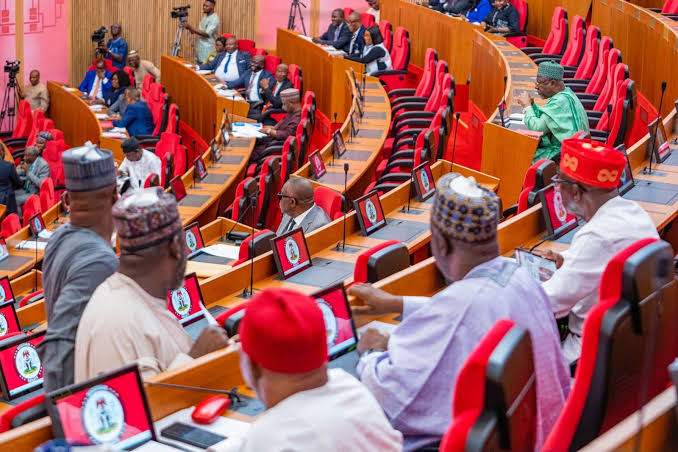
The Nigerian Senate has called on the Federal Government to renegotiate the Bilateral Air Services Agreement, BASA, between Nigeria and China to secure direct flight opportunities for Nigerian airlines.
The lawmakers want Nigerian carriers to enjoy reciprocal access to the Chinese aviation market, arguing that the current arrangement does not provide equal opportunities for airlines from both countries.
The resolution follows a motion sponsored by the Senate Chief Whip, Senator Mohammed Tahir Monguno, who drew attention to the need to review and effectively implement the existing agreement.
Leading the debate, Monguno recalled that the BASA was signed during the administration of former President Muhammadu Buhari to establish direct commercial air links between Nigeria and China.
He also highlighted the proposal for a direct naira settlement window through the bilateral currency swap framework, which could reduce dependence on the United States dollar in certain bilateral transactions.
The senator argued that direct flights would reduce travel time, improve trade and supply-chain efficiency, create opportunities for Nigerian businesses and help retain foreign exchange within the country.
He also identified the Murtala Muhammed International Airport in Lagos and the Nnamdi Azikiwe International Airport in Abuja as potential gateways connecting West and Central Africa to East Asia.
Contributing to the debate, lawmakers stressed the importance of reciprocity, insisting that Nigerian airlines should enjoy the same flight privileges granted to Chinese carriers operating in Nigeria.
Senate President Godswill Akpabio also warned that Nigeria may need to reconsider the existing aviation arrangement if Nigerian airlines are denied equivalent access to China.
The Senate consequently urged the Federal Ministry of Aviation and Aerospace Development to renegotiate the commercial terms and operational schedules of the agreement.
It also called on the Ministry of Foreign Affairs to engage Chinese authorities on business visa facilitation for Nigerian traders and reciprocal allocation of flight slots.
Meanwhile, the debate reopened discussions about Nigeria’s need for a viable national carrier.
Several lawmakers highlighted the potential benefits, including job creation, reduced capital flight, stronger national security and improved capacity for emergency response.
However, the Senate ruled out reviving the contracts associated with the controversial Nigeria Air project, while urging the Federal Government to explore options for establishing a viable national airline through a separate process.
To ensure implementation of its resolutions, the Senate mandated its Committees on Aviation and Foreign Affairs to monitor compliance and report back within four weeks.
The proposed renegotiation of the Nigeria-China aviation agreement now places the Federal Government under pressure to secure a more balanced arrangement that gives Nigerian airlines greater access to international routes.