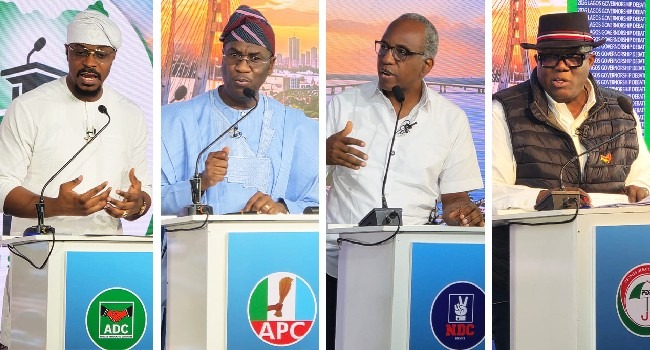
The 2026 Lagos governorship debate has opened with opposition candidates raising tough questions about traffic congestion, recurring flooding, unaffordable housing, poor urban planning and the rising cost of living, challenging successive administrations to explain why Africa’s largest commercial hub continues to struggle with these problems.
The debate, which brought together leading governorship candidates, is organised by the 2026 Debate Consortium, a partnership involving PUNCH Nigeria Limited, Channels Television, TVC, TheCable and Vanguard Newspaper.
The candidates confronted the All Progressives Congress candidate, Obafemi Hamzat, over the state’s development priorities, with the opposition insisting that Lagos has the resources and economic potential to deliver a better standard of living for its residents.
One of the major issues was the persistent traffic congestion and the state of public transportation.
The Nigeria Democratic Congress candidate, Funso Doherty, criticised the continued reliance on ageing commercial buses, describing the existing transportation system as inadequate for a rapidly growing megacity.
He questioned why successive governments had failed to modernise the public transportation network, arguing that the problem went beyond infrastructure to a lack of political will.
Doherty alleged that vested interests within the informal transport system, particularly the structure commonly associated with agberos, had frustrated efforts to introduce a more efficient and organised transportation arrangement.
He maintained that Lagos residents deserved a modern public transport system that was safer, more reliable and capable of reducing the pressure on the city’s roads.
The African Democratic Congress candidate, Gbadebo Rhodes-Vivour, also presented an alternative transportation vision, proposing the expansion of rail and water transportation, alongside the introduction of cable car services.
He argued that Lagos needed a comprehensive transportation network connecting different communities and reducing dependence on road transport.
Rhodes-Vivour said proposed rail infrastructure could be delivered within two and a half years through private sector participation and infrastructure financing, rather than placing the entire financial burden on the state government.
He maintained that the projects could generate revenue over a 30-year period to repay investments.
He also proposed expanding the eastern foreshore and constructing shorter bridges to improve connectivity between communities around the Ibeju-Lekki axis and other parts of Lagos.
On flooding, the candidates expressed sharply different views about the government’s responsibility and the impact of climate change.
Rhodes-Vivour accused the government of poor environmental planning, warning that development decisions in a low-lying coastal state such as Lagos must take climate risks seriously.
He specifically questioned the reported sand-filling of parts of Makoko, arguing that such interventions could worsen flooding if their environmental consequences were not properly assessed.
He challenged the state to learn from countries such as Japan and the Netherlands, which have developed sophisticated approaches to managing water, drainage and coastal environments.
Hamzat acknowledged that climate change and excessive rainfall posed serious threats to Lagos.
He explained that the state had an extensive drainage network but stressed the importance of keeping the channels clear to ensure they function effectively.
Doherty, however, rejected the argument that climate change should become an excuse for recurring flooding.
He insisted that effective planning, proper drainage management and consistent maintenance could significantly reduce the impact of heavy rainfall.
The debate also examined the growing housing crisis, particularly rising rents and the difficulties faced by low- and middle-income residents.
Hamzat defended the Lagos State Real Estate Regulatory Authority law passed in 2025, saying it provides for the payment of one year’s rent and that the government’s priority should now be effective enforcement.
Rhodes-Vivour proposed stronger tenant protection, including legislation requiring landlords to give at least six months’ notice before increasing rents.
Doherty argued that the fundamental problem was the shortage of affordable housing compared with the state’s rapidly expanding population.
He maintained that regulating landlords alone would not solve the crisis unless government increased the supply of residential accommodation.
The Peoples Democratic Party candidate, Deji Doherty, proposed another approach, suggesting that government could rent or build houses and make them available to residents at affordable rates.
Beyond infrastructure and housing, the debate turned to economic inequality and the rising cost of living.
Rhodes-Vivour accused successive Lagos administrations over the past two decades of implementing policies that disproportionately favoured wealthy residents and privileged interests.
He promised to build a cleaner, safer and more affordable Lagos where development opportunities would benefit everyone, not just a privileged minority.
Funso Doherty said his proposed administration would prioritise skills development, human capacity building and access to education, insisting that no child should be denied an opportunity to learn because of their parents’ financial circumstances.
Hamzat acknowledged the economic difficulties confronting residents, describing the country as undergoing a financial correction.
He, however, maintained that the Lagos State Government could intervene more directly in critical sectors, particularly housing, agriculture and transportation.
For Doherty, his decision to contest the governorship election is driven by his conviction that Lagos is operating below its economic potential and that residents are not benefiting sufficiently from the opportunities available in the state.
The opening debate has therefore brought the challenges confronting Lagos into sharp focus, with candidates presenting competing ideas on how to address the problems affecting millions of residents.
As the 2027 governorship election approaches, the critical question for Lagosians is no longer simply who can make the biggest promises, but who has the vision, competence, political will and practical solutions to transform those promises into measurable results.
For a state that contributes significantly to Nigeria’s economy, residents will be looking for a government that delivers affordable housing, reliable transportation, effective flood management and inclusive economic opportunities.