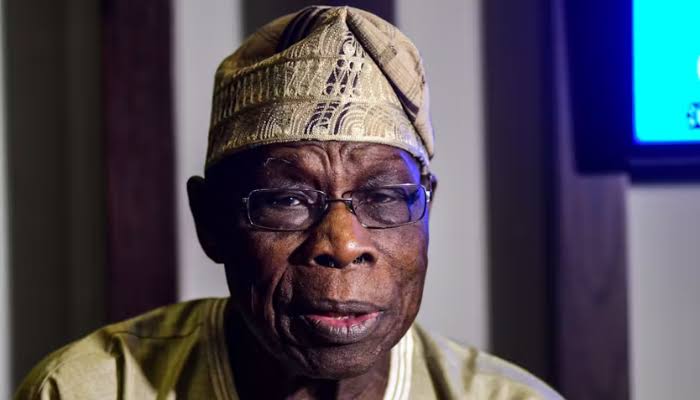
Former President Olusegun Obasanjo has criticised the Federal Government’s continued reliance on domestic and foreign loans, warning that excessive borrowing could impose a devastating financial burden on generations of Nigerians yet unborn.
Obasanjo described debt as more damaging than leprosy, arguing that while the disease affects an individual, the consequences of unsustainable borrowing could extend across generations.
The former president made the remarks on Friday in Abeokuta, Ogun State, during the Ajibosin Platform, a public forum themed, “Leveraging Artificial Intelligence to Solve Grassroots Problems and Accelerate National Development.”
His comments come amid growing public debate over the Tinubu administration’s borrowing plans and the country’s capacity to meet its rising debt obligations.
Reacting to President Bola Tinubu’s earlier defence of government borrowing, Obasanjo dismissed the comparison of debt with leprosy.
He said, “And for anybody to say debt is no leprosy, is absolute nonsense. Debt is worse than leprosy. Because leprosy destroys only one person. Debt destroys generations.”
President Tinubu has consistently defended borrowing as a necessary instrument for financing critical infrastructure, stimulating economic activities and addressing the country’s development challenges.
On Thursday, the president maintained that the focus should not be on how much the country borrows but on the value generated from the borrowed funds.
He said, “The real question is not how much we borrow, but what we build, what value we create and what future we leave behind.”
The president had also declared in April that his administration would borrow whenever necessary, provided the country worked hard to repay its obligations.
However, Obasanjo’s criticism comes against the background of fresh borrowing proposals submitted by the Tinubu administration.
On Tuesday, President Tinubu sought the National Assembly’s approval to process external loans valued at approximately 20.5 billion dollars and 1.05 billion euros under the 2026–2027 Supplementary External Borrowing Plan.
This followed the legislature’s approval of a 516.3-million-dollar loan from Deutsche Bank AG to finance the Sokoto–Badagry Superhighway.
In March, the National Assembly also approved a six-billion-dollar external borrowing plan, including five billion dollars from First Abu Dhabi Bank to support the national budget and a one-billion-dollar export finance facility for the rehabilitation of Tin Can Island Port and Lagos Port Complex.
Beyond the borrowing debate, Obasanjo questioned Nigeria’s economic performance over the past decades, particularly the dramatic depreciation of the naira against the United States dollar.
Reflecting on his agricultural investment, which he started 47 years ago, the former president recalled that the naira exchanged at approximately one dollar to 1.85 naira at the time.
He questioned how the country moved from that exchange-rate position to levels exceeding 1,500 naira to the dollar.
Obasanjo also expressed reservations about Nigeria’s dependence on international financial institutions, particularly the World Bank and the International Monetary Fund.
According to him, these institutions were established before Nigeria’s independence and were not specifically designed to address the country’s unique economic circumstances.
He further cautioned against adopting foreign economic prescriptions without adequately considering Nigeria’s realities and development priorities.
Meanwhile, Nigeria’s rising public debt continues to attract attention from economists and development experts, particularly over the relationship between government revenue, debt servicing and available resources for public infrastructure and social services.
Although borrowing can provide funding for major development projects, concerns persist over the country’s revenue-generating capacity and the economic returns on borrowed funds.
The Federal Government has maintained that its borrowing strategy is necessary to bridge infrastructure gaps, finance budgetary obligations and support economic growth.
The debate now centres on whether borrowed funds can generate sufficient economic value to justify their cost while protecting the financial interests of future generations.