
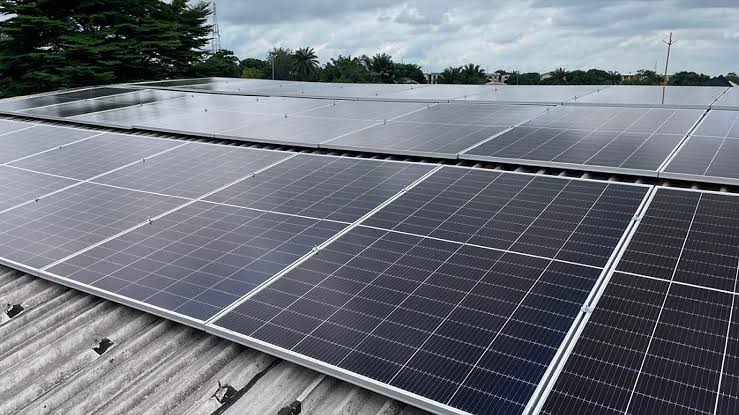
The Federal Government has shelved plans to immediately ban solar panel imports, following concerns that the move could increase electricity costs, disrupt supply and slow Nigeria’s transition to clean energy.
The Minister of Innovation, Science and Technology, Kingsley Udeh, announces the decision on Friday, saying the government will focus on ensuring that solar panels sold in Nigeria meet required quality standards, whether they are locally manufactured or imported.
Mediaplusng.com reports that Nigeria continues to depend heavily on imported solar equipment as households and businesses seek alternatives to unreliable grid electricity and expensive petrol and diesel generators.
Data from Chinese customs, cited by energy think tank Ember, show that China exports 2.4 gigawatts of solar panels to Nigeria in the 12 months to August 2026. The shipments are valued at 269 million dollars.
Energy analysts estimate that generating an equivalent amount of electricity with diesel-powered generators could cost about 980 million dollars annually. This suggests potential savings of more than 700 million dollars a year if solar power fully replaces diesel-generated electricity.
Speaking on the Nigerian Television Authority, Minister Udeh says the government cannot ban solar imports while local manufacturers lack the capacity to meet national demand.
He explains that the Renewed Hope Solarisation Project is helping federal universities and other specialised institutions gain access to electricity.
The minister adds that the government wants to ensure that only standard-quality solar panels, produced locally or imported from reliable sources, enter the Nigerian market.
The decision offers relief to solar importers, installers and consumers who fear that an immediate ban could increase equipment prices and disrupt off-grid electricity projects.
The President of the Renewable Energy Association of Nigeria, Ayo Ademilua, welcomes the government’s position but stresses that local factories are not yet able to meet the country’s demand in both volume and price.
He says the association supports domestic manufacturing, with some members already investing in local assembly and production. However, he warns that restricting imports too early could raise costs, delay projects and undermine progress in expanding solar power access.
Ademilua notes that solar energy has become an important source of electricity for homes, hospitals, schools, farms and small businesses, particularly in areas with limited access to the national grid.
The Executive Director of the Global Initiative for Food Security and Ecosystem Preservation, Dr David Michael, also supports the decision. He urges the government to develop a long-term plan that encourages local manufacturing while keeping clean energy affordable.
Similarly, Muhammad Mustafa Amjad, Programme Director of Renewables First in Pakistan, says Nigeria can learn from Pakistan’s experience, where affordable solar equipment helps households and businesses reduce their dependence on conventional electricity supplies.
Nigeria Campaign Director of the Secure Energy Project, Joseph Ibrahim, also welcomes the decision, describing affordable solar access as a national priority.
He calls for policies that attract investment, support local manufacturers and eventually enable Nigerian-made solar panels to compete with imports on price and quality.
The controversy dates back to March 2025, when former minister Uche Nnaji proposed restricting solar panel imports to encourage domestic production. Although the Rural Electrification Agency previously indicated that restrictions would not be introduced until local capacity could meet demand, uncertainty over the proposal continued to concern industry operators.
Renewable energy advocates are now calling for a phased transition over three to five years, backed by clear timelines, incentives for manufacturers and measurable production targets.
For Nigeria, the challenge is to grow a competitive domestic solar industry without pricing millions of households and businesses out of access to reliable and affordable electricity.